
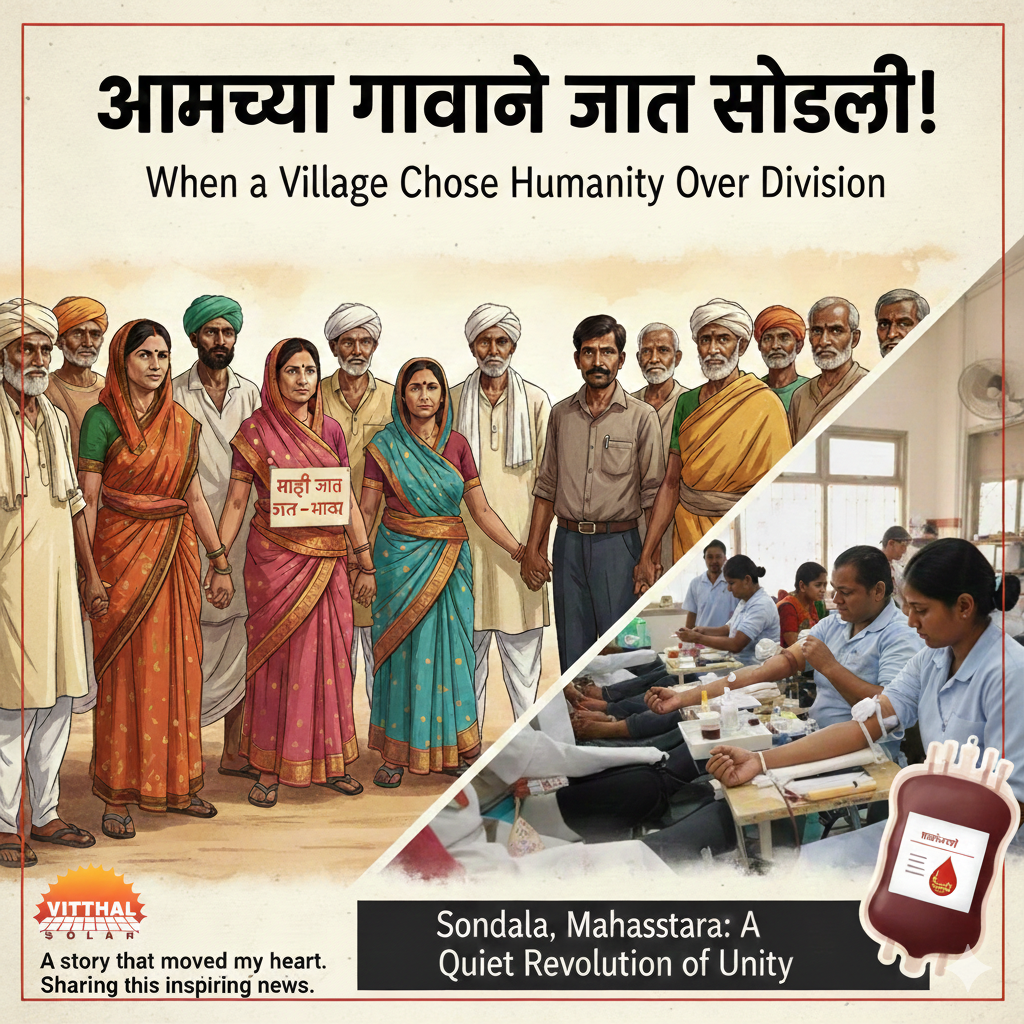
In a quiet yet powerful declaration, a village in Maharashtra made a statement that echoed far beyond its boundaries: “आमच्या गावाने जात सोडली!” — Our village has given up caste. These are not just words. They are a decision. A resolution. A collective shift in identity. Sondala village, in Taluka Nevasa of Ahmednagar district, has chosen to define itself not by caste labels — but by humanity. And that choice matters. The Resolution That Redefined Identity In a Gram Sabha meeting attended by villagers, Sondala formally passed a resolution declaring itself a caste-free village. The decisions were clear and deliberate: No discrimination based on caste, religion, sect, or lineage. Encouragement of inter-caste marriages. No caste-based references in public places, government services, social or religious events. No caste-identifying messages on social media by villagers. Adoption of a shared belief: “माझी जात – मानव” (My caste is Human). This was not symbolic language without action. It was a structured commitment taken through democratic consensus. The resolution was approved in the Gram Sabha and will be forwarded to the government — making it not just an emotional announcement, but an administrative declaration. Why This Decision Is Socially Significant For generations, caste identity has shaped social interaction in many parts of rural India. It has influenced marriages, public life, access to services, and even everyday conversations. Sondala’s decision challenges that pattern — not with confrontation, but with collective understanding. By declaring that no citizen in the village will be treated differently on the basis of caste, the community has: Shifted the basis of identity from hierarchy to equality. Opened doors for inter-caste marriages without stigma. Removed caste references from public and official spaces. Chosen social harmony over inherited division. This move is not about denying history. It is about choosing the future. The phrase “My caste is Human” simplifies what has long been complicated. It reframes identity in a way that centers dignity rather than difference. That shift, especially when taken unanimously, reflects courage and maturity at the grassroots level. The Symbolism of Blood Donation During the Gram Sabha where this resolution was passed, villagers participated in blood donation. This act carried deep symbolism. Blood has no caste. It has no religion. It has no surname. When blood flows from one person to save another, it carries only one identity — human life. By donating blood on the day they declared themselves caste-free, the people of Sondala reinforced their message not only through words, but through action. It was a reminder that beneath social categories, we share the same biology, the same vulnerability, and the same need for one another. Unity was not just discussed. It was practiced. A Community-Led Transformation What makes this story powerful is not just the resolution — it is the collective agreement behind it. This was not imposed from outside. It was not a campaign slogan. It was a village choosing its own direction. The decision reflects thoughtful leadership, active participation, and a willingness to evolve. Public spaces, government schemes, Gram Panchayat services, social events, weddings, and festivals — all will now consciously avoid caste-based identification. Even social media communication within the village will reflect this commitment. This level of clarity shows that the intention is not symbolic. It is practical. A Message to Other Villages and Communities Sondala’s declaration is not a command to others. It is an example. It demonstrates that social reform does not always begin with national policy. Sometimes, it begins in a Gram Sabha meeting — with neighbors sitting together and deciding what kind of future they want. Other villages may take inspiration in their own way. The lesson is simple: Communities have the power to redefine themselves. Change does not always require large-scale movements. Sometimes it requires consensus, courage, and a shared belief in equality. Choosing Humanity “आमच्या गावाने जात सोडली!” is more than a headline. It is a statement of identity. By declaring themselves caste-free, the people of Sondala have affirmed a fundamental principle: Every citizen is equal. Every person deserves dignity. Every human being shares the same blood. In choosing to say “My caste is Human, ” the village has placed humanity at the center of its social fabric. It is a quiet revolution — rooted not in protest, but in unity. And in that unity lies its strength. A story that truly moved my heart — and I felt compelled to share it. In a time when divisions often dominate headlines, this inspiring decision by a small village in Maharashtra reminded me of the power of unity, courage, and humanity. Some stories deserve to be told. This is one of them. एक अशी कहाणी जी खरोखरच माझ्या हृदयाला भिडली - आणि मला ती शेअर करायला भाग पाडले गेले. ज्या काळात विभाजने बहुतेकदा मथळ्यांवर अधिराज्य गाजवतात, त्या काळात महाराष्ट्रातील एका छोट्या गावाने घेतलेल्या या प्रेरणादायी निर्णयाने मला एकता, धैर्य आणि मानवतेच्या शक्तीची आठवण करून दिली. काही कथा सांगितल्या पाहिजेत. ही त्यापैकी एक आहे.


This is your website preview.
Currently it only shows your basic business info. Start adding relevant business details such as description, images and products or services to gain your customers attention by using Boost 360 android app / iOS App / web portal.
“आमच्या गावाने जात सोडली!” When a Village Chose Humanity Over Division
2026-02-11T04:37:45
In a quiet yet powerful declaration, a village in Maharashtra made a statement that echoed far beyond its boundaries: “आमच्या गावाने जात सोडली!” — Our village has given up caste. These are not just words. They are a decision. A resolution. A collective shift in identity. Sondala village, in Taluka Nevasa of Ahmednagar district, has chosen to define itself not by caste labels — but by humanity. And that choice matters. The Resolution That Redefined Identity In a Gram Sabha meeting attended by villagers, Sondala formally passed a resolution declaring itself a caste-free village. The decisions were clear and deliberate: No discrimination based on caste, religion, sect, or lineage. Encouragement of inter-caste marriages. No caste-based references in public places, government services, social or religious events. No caste-identifying messages on social media by villagers. Adoption of a shared belief: “माझी जात – मानव” (My caste is Human). This was not symbolic language without action. It was a structured commitment taken through democratic consensus. The resolution was approved in the Gram Sabha and will be forwarded to the government — making it not just an emotional announcement, but an administrative declaration. Why This Decision Is Socially Significant For generations, caste identity has shaped social interaction in many parts of rural India. It has influenced marriages, public life, access to services, and even everyday conversations. Sondala’s decision challenges that pattern — not with confrontation, but with collective understanding. By declaring that no citizen in the village will be treated differently on the basis of caste, the community has: Shifted the basis of identity from hierarchy to equality. Opened doors for inter-caste marriages without stigma. Removed caste references from public and official spaces. Chosen social harmony over inherited division. This move is not about denying history. It is about choosing the future. The phrase “My caste is Human” simplifies what has long been complicated. It reframes identity in a way that centers dignity rather than difference. That shift, especially when taken unanimously, reflects courage and maturity at the grassroots level. The Symbolism of Blood Donation During the Gram Sabha where this resolution was passed, villagers participated in blood donation. This act carried deep symbolism. Blood has no caste. It has no religion. It has no surname. When blood flows from one person to save another, it carries only one identity — human life. By donating blood on the day they declared themselves caste-free, the people of Sondala reinforced their message not only through words, but through action. It was a reminder that beneath social categories, we share the same biology, the same vulnerability, and the same need for one another. Unity was not just discussed. It was practiced. A Community-Led Transformation What makes this story powerful is not just the resolution — it is the collective agreement behind it. This was not imposed from outside. It was not a campaign slogan. It was a village choosing its own direction. The decision reflects thoughtful leadership, active participation, and a willingness to evolve. Public spaces, government schemes, Gram Panchayat services, social events, weddings, and festivals — all will now consciously avoid caste-based identification. Even social media communication within the village will reflect this commitment. This level of clarity shows that the intention is not symbolic. It is practical. A Message to Other Villages and Communities Sondala’s declaration is not a command to others. It is an example. It demonstrates that social reform does not always begin with national policy. Sometimes, it begins in a Gram Sabha meeting — with neighbors sitting together and deciding what kind of future they want. Other villages may take inspiration in their own way. The lesson is simple: Communities have the power to redefine themselves. Change does not always require large-scale movements. Sometimes it requires consensus, courage, and a shared belief in equality. Choosing Humanity “आमच्या गावाने जात सोडली!” is more than a headline. It is a statement of identity. By declaring themselves caste-free, the people of Sondala have affirmed a fundamental principle: Every citizen is equal. Every person deserves dignity. Every human being shares the same blood. In choosing to say “My caste is Human, ” the village has placed humanity at the center of its social fabric. It is a quiet revolution — rooted not in protest, but in unity. And in that unity lies its strength. A story that truly moved my heart — and I felt compelled to share it. In a time when divisions often dominate headlines, this inspiring decision by a small village in Maharashtra reminded me of the power of unity, courage, and humanity. Some stories deserve to be told. This is one of them. एक अशी कहाणी जी खरोखरच माझ्या हृदयाला भिडली - आणि मला ती शेअर करायला भाग पाडले गेले. ज्या काळात विभाजने बहुतेकदा मथळ्यांवर अधिराज्य गाजवतात, त्या काळात महाराष्ट्रातील एका छोट्या गावाने घेतलेल्या या प्रेरणादायी निर्णयाने मला एकता, धैर्य आणि मानवतेच्या शक्तीची आठवण करून दिली. काही कथा सांगितल्या पाहिजेत. ही त्यापैकी एक आहे.
2026-02-11T04:37:45


Keywords
- सामाजिक परिवर्तन ग्रामीण महाराष्ट्र
- जातीयवादी विभाजन विरोधी आंदोलन महाराष्ट्र
- भारतातील जातीय विभाजन विरोधी सामाजिक सुधारणा
- महाराष्ट्र गावात मानवता प्राथमिकता
- ग्राम सभा निर्णय जात मुक्त
- महाराष्ट्रातील जातीय एकता संदेश
- जातवाचक कमी करणारे सामाजिक निर्णय
- जातीयवाद विरोधी गांव
- समाजिक शिक्षण महाराष्ट्र
- जात सोडलेली गाव महाराष्ट्र
Submit Your Enquiry